1 Introduction
The European Accessibility Act (EAA) is a law that aims to make everyday products and services more accessible for people with disabilities. It covers items such as computers, smartphones, websites, automated teller machines (s), e-books, and public transport ticketing systems. The goal is to remove barriers so that everyone in the EU can access essential tools and services more equally.
If a product falls within the scope of the EAA, it may need to meet specific accessibility requirements. For example, smartphones and s might be required to offer screen readers for users with visual impairments or provide clear audio instructions. Websites and apps may need to function with assistive technologies and be easily navigable via keyboard. These rules are intended to ensure that people with disabilities can use such products and services independently and effectively.
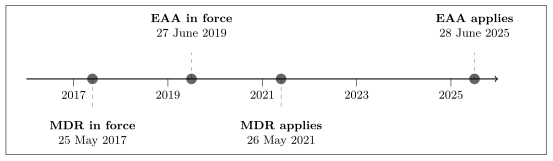
Recently, some posts and presentations have suggested that the EAA will apply to all medical devices, creating the impression of a new regulatory burden for the metech industry. These messages often cite June 28th, 2025—the date the EAA comes into force, Figure 1—as a deadline for widespread compliance.
In this article, we argue that the actual impact of the EAA on medical devices is far more limited.
To begin with, it is worth noting that the EAA places little emphasis on medical devices. In fact, medical devices are not explicitly mentioned in the articles of the directive. Instead, the only reference appears in a cautionary note within one of the recitals, which acknowledges that some products or services covered by the EAA—particularly assistive technologies—may also qualify as medical devices:
EAA, Recital 51
Products and services falling within the scope of this Directive do not automatically fall within the scope of Council Directive 93/42/EEC (16). However, some assistive technologies which are medical devices, might fall within the scope of that Directive.
where "assistive technology" is defined in Article 3 as
‘Assistive technology’
EAA, Article 3(37)
means any item, piece of equipment, service or product system including software that is used to increase, maintain, substitute or improve functional capabilities of persons with disabilities or for, alleviation and compensation of impairments, activity limitations or participation restrictions.
In Recital 61, mentioned above, the EAA refers to the MDD rather than the MDR, because at the time the EAA entered into force (2019), the MDR had not yet become applicable (see Figure 1). In this context, one might interpret the inclusion of the term disability in the MDR as a possible attempt to align the medical device framework with the objectives of the EAA. Notably, during the the transition from the MDD to the MDR the definition of "medical device" was revised—replacing the term handycap with disability, as shown in the redline text below:
‘Medical device’ (first pragraph)
means any instrument, apparatus, appliance, material
software, implant, reagent, material or other article,
whether used alone or in combination , intended by the manufacturer to be used, including the
software necessary for its proper application,
intended by the manufacturer to be used, alone or in combination, for
human beings for the purpose of
one or more of the following specific medical purposes:
-
diagnosis, prevention, monitoring, prediction, prognosis, treatment or alleviation of disease,
-
diagnosis, monitoring, treatment, alleviation of, or compensation for an injury or
handicapdisability, -
investigation, replacement or modification of the anatomy or of a physiological or pathological process or state,
-
control of conceptions, -
providing information by means of in vitro examination of specimens derived from the human body, including organ, blood and tissue donations,
and which does not achieve its principal intended action in or on the human body by
pharmacological, immunological or metabolic means,
in or on the human body, but which may be assisted in its function by
such means. […]
However, if we look at how the EAA defines disability, it becomes clear that the idea of a direct link to the MDR wording is not supported. The EAA defines disability as follows:
‘Persons with disabilities’
EAA, Article 3(37)
means persons who have long-term physical, mental, intellectual or sensory impairments which in interaction with various barriers may hinder their full and effective participation in society on an equal basis with others.
This definition aligns with the United Nations Convention on the Rights of Persons with Disabilities, adopted on 13 December 2006 (EAA, Recital 3), which, as explained by the EU Commission in the AccessibleEU Report, is based on the social model of disability, which focuses not on a person’s medical condition, but rather on their interaction with their environment, and the barriers created by society. This means that the definition of disability in the EAA includes subjects that might not be considered clinically disabled.
It is important to keep this distinction in mind, as the key factor in determining the applicability of the EAA is the intended user of the medical device—not the target population (i.e., the patient). Some devices may have intended users who qualify as disabled under the social model of disability, even if they are not clinically disabled. This is especially relevant when the user is the patient or a layperson, rather than a healthcare professional.
However, as this document will show, the scope of the EAA is narrowly defined and applies primarily to types of products that are unlikely to correspond to most currently marketed medical devices.
All in all, the EAA affects a narrow subset of medical devices. Most likely devices which are assistive technologies intended to enable patients with disabilities accessing and navigating today’s digital world. To clarify this point, in the rest of this article we provide a detailed analysis of points 1 to 3 of Article 2 of the EAA, which defines the scope of the Act. This analysis can be used within your QMS to justify why your device does not fall under the EAA’s requirements.
Before we proceed, a final note. The EAA is a directive, meaning it must be transposed into national law by each EU Member State. While the directive sets common goals, each country can introduce additional or country-specific requirements during transposition. As a result, compliance obligations may vary slightly depending on the Member State. Readers can find the national implementing measures for the EAA at the following link: EUR-Lex – National Transpositions of Directive 2019/882.
2 Detailed analysis of the EAA scope (Article 2)
In the following sections, we break down Article 2 of the EAA, presenting each sentence of the article as a section or subsection heading, followed by a detailed analysis in the corresponding body text. For each part, we also provide a qualitative likelihood that medical devices currently on the market would fall under that specific element of the EAA’s scope.
2.1 This Directive applies to the following products placed on the market after 28 June 2025
The EAA entered into force in 2019; however, its rules only begin to apply to manufacturers, authorities, and other stakeholders from 28 June 2025, Figure 1. The opening sentence of Article 2(1) of the EAA underscores this and provides an important clarification: the regulation does not apply retroactively. As a result, devices that fall within the scope of the act but were placed on the market before the application date (28 June 2025) are not subject to its requirements and do not need to be modified.
‘Placing on the market’
MDR, Article 2(28)
means the first making available of a device, other than an investigational device, on the Union market.
2.1(a) Consumer general‑purpose computer hardware systems and operating systems for those hardware systems (UNLIKELY)
Due to their specialized functions, medical devices are inherently purpose-built rather than general-purpose. As such, the definition of a consumer general purpose computer hardware system under the EAA is generally not applicable to medical device:
‘Consumer general purpose computer hardware system’
EAA, Article 3(39)
means the combination of hardware which forms a complete computer, characterised by its multipurpose nature, its ability to perform, with the appropriate software, most common computing tasks requested by consumers and intended to be operated by consumers, including personal computers, in particular desktops, notebooks, smartphones and tablets;
2.1(b) The following self-service terminals:
2.1(b)(i) Payment terminals (UNLIKELY)
It is theoretically conceivable that a device could fulfill the definition of a medical device under the MDR while having as its primary purpose the facilitation of payments. However, it is difficult to identify any such device currently available on the market.
‘Payment terminal’
EAA, Article 3(29)
means a device the main purpose of which is to allow payments to be made by using payment instruments as defined in point 14 of Article 4 of Directive (EU) 2015/2366 at a physical point of sale but not in a virtual environment;
2.1(b)(ii) The following self-service terminals dedicated to the provision of services covered by this Directive: (UNLIKELY)
In principle, an assistive technology could allow clinically disabled patients as a self-service terminal—such as an automated teller machine or an interactive terminal providing information. However, for a device to fall under the scope of Article 2.1b(ii), it is not sufficient for it to simply belong to one of the four listed categories:
automated teller machines,
ticketing machines,
check-in machines,
-
or interactive self-service terminals providing information, excluding those integrated into vehicles, aircraft, ships, or rolling stock.
The article also requires that the services provided by the device fall within the scope of services covered by the EAA. These services are enumerated in Article 2.2 and will be analyzed in the following sections. As we will see, it is overall unlikely that many medical devices will meet the service-related criteria required under this provision.
2.1(c) Consumer terminal equipment with interactive computing capability, used for electronic communications services (RARE)
The EAA does not explicitly define this category of devices. However, in the context of electronic communications services, Recitals 28, 29, and 45 of the EAA refer to the definitions provided in the EECC:
‘Electronic communications services’
EECC, Article 2(4)
means a service normally provided for remuneration via electronic communications networks, which encompasses, with the exception of services providing, or exercising editorial control over, content transmitted using electronic communications networks and services, the following types of services:
-
‘internet access service’ as defined in point (2) of the second paragraph of Article 2 of Regulation (EU) 2015/2120;
interpersonal communications service; and
-
services consisting wholly or mainly in the conveyance of signals such as transmission services used for the provision of machine-to-machine services and for broadcasting;
In this context, internet access service refers to access to the entire internet Net Neutrality Regulation (Regulation (EU) 2015/2120). For example, an assistive technology that enables patients to access the internet may fall within the scope of this device group.
Some medical devices do incorporate communication capabilities. However, it is important to note that the definition of interpersonal communications service in the EECC is narrowly framed. Specifically, two conditions must be met: first, the user must be able to determine the recipients of the communication; and second, the communication functionality must constitute a principal feature of the device:
‘Interpersonal communications service’
EECC, Article 2(5)
means a service normally provided for remuneration that enables direct interpersonal and interactive exchange of information via electronic communications networks between a finite number of persons, whereby the persons initiating or participating in the communication determine its recipient(s) and does not include services which enable interpersonal and interactive communication merely as a minor ancillary feature that is intrinsically linked to another service;
2.1d consumer terminal equipment with interactive computing capability, used for accessing audiovisual media services (RARE)
Unlike for Article 2.1c, the EAA provides a specific definition of this article subpoint:
‘consumer terminal equipment with interactive computing capability, used for accessing audiovisual media services’
EAA, Article 3(7)
means any equipment the main purpose of which is to provide access to audiovisual media services;
This wording emphasizes that the primary purpose of the device must be to deliver audiovisual content. To understand what qualifies as an audiovisual media service, we must refer to the definition provided in the AVMSD (EAA, Recital 31):
‘Audiovisual media service’
AVMSD, Article 1.1(a)
means
-
a service as defined by Articles 56 and 57 of the Treaty on the Functioning of the European Union which is under the editorial responsibility of a media service provider and the principal purpose of which is the provision of programmes, in order to inform, entertain or educate, to the general public by electronic communications networks within the meaning of point (a) of Article 2 of Directive 2002/21/EC. Such an audiovisual media service is either a television broadcast as defined in point (e) of this paragraph or an on-demand audiovisual media service as defined in point (g) of this paragraph;
audiovisual commercial communication;
Here, audiovisual commercial communication is further defined as:
‘Audiovisual commercial communication’
AVMSD, Article 1.1(h)
means images with or without sound which are designed to promote, directly or indirectly, the goods, services or image of a natural or legal entity pursuing an economic activity. Such images accompany or are included in a programme in return for payment or for similar consideration or for self-promotional purposes. Forms of audiovisual commercial communication include, inter alia, television advertising, sponsorship, teleshopping and product placement;
On this basis, a medical device that delivers educational content—such as medical training materials—targeted at patients or their carers—could, in theory, fall under this category, provided that its primary purpose is the provision of audiovisual media services and the medical purpose is the ancillary one.
2.1(e) E-readers (RARE)
The EAA defines an e-reader as:
‘e-reader’
EAA, Article 3(42)
means dedicated equipment, including both hardware and software, used to access, navigate, read and use e-book files;
In order for a device to be considered an e-reader under the EAA, it is not sufficient for it to merely display digital information. The device must specifically be intended to display e-book files. While the directive does not provide a formal definition of e-book file, Recital 42 offers context:
EAA, Recital 42
E-book files are based on an electronic computer coding that enables the circulation and consultation of a mostly textual and graphical intellectual work. […]
This suggests that an e-book file is not just any digital document but a structured digital publication resembling traditional books, typically intended for reading by the general public.
Therefore, a medical device or system used to display patient-specific data, such as electronic health records, would not be considered an e-reader under the EAA. However, if a device is specifically intended to access and read standard e-book content, then it may fall under the scope of the EAA as an e-reader.
2.2 Without prejudice to Article 32, this Directive applies to the following services provided to consumers after 28 June 2025:
The second part of EAA Article 2 outlines the services that fall within the scope of the Directive. These include a range of digital and transport-related services—such as electronic communications, e-commerce platforms, banking, e-books, and passenger transport—which must meet the accessibility requirements when offered to consumers from 28 June 2025 onward.
For services, the concept of placing on the market is less clearly defined than it is for physical products. Therefore, EAA Article 32 provides transitional provisions that allow services already in use before 28 June 2025 to continue operating without immediate need for compliance.
2.2(a) electronic communications services with the exception of transmission services used for the provision of machine-to- machine services; (RARE)
The same considerations apply as those outlined for the scope of Article 2.1(c).
2.2(b) services providing access to audiovisual media services; (RARE)
The same considerations apply as those outlined for the scope of Article 2.1(d).
2.2(c) the following elements of air, bus, rail and waterborne passenger transport services, except for urban, suburban and regional transport services for which only the elements under point (v) apply: (UNLIKELY)
While it is not impossible that medical devices could one day be integrated into passenger transport services, particularly in accessibility-related contexts, it is currently difficult to identify any medical device that would fall under this provision.
2.2(d) consumer banking services (UNLIKELY)
It is unlikely that any currently marketed medical device falls under the EAA definition of consumer banking services:
‘Consumer banking services’
EAA, Article 3(28)
means the provision to consumers of the following banking and financial services:
-
credit agreements covered by Directive 2008/48/EC of the European Parliament and of the Council or Directive 2014/17/EU of the European Parliament and of the Council;
-
services as defined in points 1, 2, 4 and 5 in Section A and points 1, 2, 4 and 5 in Section B of Annex I to Directive 2014/65/EU of the European Parliament and of the Council;
-
payment services as defined in point 3 of Article 4 of Directive (EU) 2015/2366 of the European Parliament and of the Council;
-
services linked to the payment account as defined in point 6 of Article 2 of Directive 2014/92/EU of the European Parliament and of the Council;
electronic money as defined under relevant EU legislation.
2.2(e) e-books and dedicated software; and (RARE)
This topic is closely related to Article 2.1(e), which concerns consumer terminal equipment for accessing audiovisual media services. Therefore, similar considerations apply. However, it is important to note that the EAA provides a specific definition for the term e-books and dedicated software:
‘e-book and dedicated software’
EAA, Article 3(41)
means a service, consisting of the provision of digital files that convey an electronic version of a book, that can be accessed, navigated, read and used and the software including mobile device-based services including mobile applications dedicated to the accessing, navigation, reading and use of those digital files, and it excludes software covered under the definition in point (42);
2.2(f) e-commerce services; (RARE)
The EAA defines
‘e-commerce services’
EAA, Article 3(30)
means services provided at a distance, through websites and mobile device-based services by electronic means and at the individual request of a consumer with a view to concluding a consumer contract;
A medical device that incorporates features such as in-app purchases or enables direct consumer transactions through digital platforms could, in theory, fall under this point. However, current medtech distribution models rarely rely on such e-commerce mechanisms.
2.3 This Directive applies to answering emergency communications to the single European emergency number ‘112’. (RARE)
Medical devices falling under this point would be subject to the requirements of the EAA. At present, such devices appear to be rare. However, this could change with the rapid advancement of AI technologies.
References
-
AccessibleEU Report — AccessibleEU Report: Accessibility Legislation at European Level. European Commission, 2023
-
AVMSD — Directive 2010/13/EU on the coordination of certain provisions laid down by law, regulation or administrative action in Member States concerning the provision of audiovisual media services (Audiovisual Media Services Directive). European Parliament and Council of the European Union, 2010
-
EAA — Directive (EU) 2019/882 on the accessibility requirements for products and services. European Parliament and Council of the European Union, 2019
-
EECC — Directive (EU) 2018/1972 establishing the European Electronic Communications Code (Recast). European Parliament and Council of the European Union, 2018
-
MDD — Council Directive 93/42/EEC of 14 June 1993 concerning medical devices (MDD). Council of the European Communities, 1993
-
MDR — Regulation (EU) 2017/745 on medical devices. European Parliament and Council of the European Union, 2024
-
Net Neutrality Regulation (Regulation (EU) 2015/2120) — Regulation (EU) 2015/2120 laying down measures concerning open internet access and retail charges for regulated intra-EU communications. European Parliament and Council of the European Union, 2015