1 Introduction
MDR Article 2.12 defines “intended purpose” as: “the use for which a device is intended”. That statement is quite circular for a definition. While the remainder of Article 2.12 emphasizes the need of consistency between information material, clinical data and intended purpose, it still does not provide much help when it comes to building an intended purpose for CE-certification. However, there is no reason to despair.
First, you probably have more experience with intended purposes than you think.
The pharmaceutical industry has been drafting intended uses for decades. When you buy a medicine, you will find a pamphlet explaining what the medication is for, who should take it, when to take it, and so on. This is the intended use of the medication. While there are differences between the intended uses of medicinal products and those of medical devices, reviewing this information can give you an idea (and also inspiration) of what an intended purpose might look like.
Furthermore, in this paper, we provide a clear methodology for defining the intended purpose of medical devices, along with examples and best practices.
Before we dive into the methodology, let’s answer a few we are frequently asked.
Frequently Asked Questions
When should I create the intended purpose?
You can think of the intended purpose as the underpinning on which the entire technical documentation of your device is built. Therefore, you should create the intended purpose as the very first piece of information in your technical file. Ideally, you should have a first version of the intended purpose before starting any development, verification, or validation activity. Do not expect to get the intended purpose perfect on the first try; you will probably need several rounds of refinement.
Is there a difference between “intended purpose” and “intended use”?
The MDR defines “intended purpose” and mentions it 83 times. However, the MDR does not define “intended use” even though it mentions it 16 times. “Intended use” is a terminology that stems from the pharma and from non-European certification systems, including the FDA. IMDRF is aware of the different terminologies and in IMDRF WG/N9 attempts to make a subtle distinction between the two expressions. However, in IMDRF WG/N47, IMDRF treats the two terms as equivalent alternatives. In the CE-certification praxis, you can consider the two terms to have the same meaning. This is also the position of MDCG 2020-6.
Where can I find good examples of intended purpose?
When creating your intended purpose, you don’t have to start from scratch. There are plenty of resources available to help you draft it.
We suggest looking at the nomenclature provided by the GMDN Agency. While the GMDN definitions do not necessarily cover all the information you need in your intended purpose, they often provide a good starting point. Another interesting source is the MeDevIs website from WHO.
How should I structure the intended purpose information?
How you structure the intended purpose information is entirely up to you. You may present it as a single paragraph, divide it into separate sections, or even organize it in a table. The key requirement is that the information is clear and easily understandable.
2 The structure of the intended purpose
The MDR does not explicitely specify a structure of the intended purpose. However, the MDCG points to the section of the MDR that they consider a specification of the content of intended purpose. Specifically, MDCG 2022-9 points to MDR Annex II, Part 1.1(c) as the requirements on the content of the intended purpose. This content includes “the intended patient population and medical conditions to be diagnosed, treated and/or monitored and other considerations such as patient selection criteria, indications, contraindications, warnings”. We can find confirmation of the MDCG approach in another part of the MDR, specifically Annex I, Part 23.4(b). This MDR section specifies that the IFU should include“the device’s intended purpose with a clear specification of indications, contra-indications, the patient target group or groups, and of the intended users, as appropriate.” This structure is reminiscent of that specified in Annex II, Part 1.1(c). All-in-all, both MDR sections, highlight a similar structure, as follows:
Indication(s)
Target population(s)
Contraindications and warnings
Intended user(s)
In this document, we propose a slightly modified structure for the intended purpose with two additional points:
Generic device group
Indication(s)
Target population(s)
Contraindications and warnings
Intended user(s)
Relevant safety and performance information
In the remaining of the document, we will analyze each element separately.
3 Generic device group
MDR Article 2.7 defines generic device group “a set of devices having the same or similar intended purposes or a commonality of technology allowing them to be classified in a generic manner not reflecting specific characteristics”. The regulation does not explicitly require the inclusion of the device group in the intended purpose. However, if the medical literature specifies standardized nomenclature to describe your device group, it is useful to provide this information at the start of the intended purpose.
Consider an example. Devices that use UVA or UVB light to treat skin conditions are commonly referred to in the medical literature as “phototherapy devices”. Using this terminology ensures that users immediately understand the type of device being described. The intended purpose of such a device can thus begin with this information:
Example: Phototherapy device = generic device group
A phototherapy device that emits UVB and UVA radiation for the treatment of psoriasis […]
4 Indication(s)
We can categorize device indications into two types:
Condition-based indications
Procedure-based indications
The following sections provide a detailed analysis of each indication type.
4.1 Condition-based indications
MDR Article 2.1 clarifies the medical purposes—such as prevention of disease, treatment of a disability, etc.—covered by the regulation. These purposes are summarized in Table 1. A large number of medical devices achieve their medical purposes for a defined set of conditions. Here we use the term "condition", which is not explicitly defined in regulatory guidance but is widely used in medicine to describe a broad category of health issues, including diseases, injuries, and disabilities, pathological processes, etc. For these devices, the indication can be specified using their medical purpose. Let’s consider some examples.
| Disease | Injury | Disability | Anatomy | Physiological process/state | Pathological process/state | |
| Diagnostic/treatment purposes | ||||||
| Prevention | • | ∘ | ∘ | ∘ | ∘ | ∘ |
| Prediction | • | ∘ | ∘ | ∘ | ∘ | ∘ |
| Prognosis | • | ∘ | ∘ | ∘ | ∘ | ∘ |
| Diagnosis | • | • | • | ∘ | ∘ | ∘ |
| Treatment | • | • | • | ∘ | ∘ | ∘ |
| Alleviation | • | • | • | ∘ | ∘ | ∘ |
| Monitoring | • | • | • | ∘ | • | • |
| Compensation | ∘ | • | • | ∘ | ∘ | ∘ |
| Investigation | ∘ | ∘ | ∘ | • | • | • |
| Replacement | ∘ | ∘ | ∘ | • | • | • |
| Modification | ∘ | ∘ | ∘ | • | • | • |
| Other purposes | ||||||
| Control of conception | ||||||
| Support of conception | ||||||
| Cleaning of devices | ||||||
| Disinfection of devices | ||||||
| Sterilization of devices |
Phototherapy devices are used to treat dermatological disorders, such as psoriasis. For diseases, the permitted purposes include treatment, alleviation, diagnosis, prevention, monitoring, prediction, and prognosis. Phototherapy devices are typically used for treatment. The indication of a phototherapy device, therefore, is to treat psoriasis. Here a possible formulation of intended purpose for such a device:
Example: Phototherapy device ( = indication )
A phototherapy device that emits UVB and UVA radiation for the treatment of psoriasis […]
Hearing aids are an example of device for compensation of a disability
Example: Bone-conduction hearing aid ( = indication )
An electrically-powered, external, acoustic device intended to compensate for impaired hearing […]
A limb prosthesis serves as a replacement for a missing or impaired part of the anatomy.
Example: Hand prosthesis ( = indication )
A hand prosthesis designed to replace the appearance of the hand […]
Devices that are medical device software or that include medical device software (see MDCG 2019-11 for a definition of medical device software) might achieve their intended purpose indirectly by providing information to the user. In such cases, it is important to emphasize this in the intended purpose. This is done by using the formulation from the first part of MDR Annex VIII, Part 6.3 (Rule 11): “provide information which is used to take decisions”. For example:
Example: Lung-cancer detection AI system ( = indication )
A software AI system intended to provide information which is used for the diagnosis lung cancer […]
A device can have several indications simultaneously. For example, the same device could treat a condition or help preventing it:
Example: Continuous passive motion ( = indication )
A continuous passive motion device intended to prevent and treat joint stiffness […]
These two indications (treatment and prevention) identify two different intended purposes of the device. It is important to be aware of the distinction since the two intended purposed might require separate considerations for certification (risk management, clinical validation, post-market surveillance, etc.).
Box 1: Indications, target population, and claims
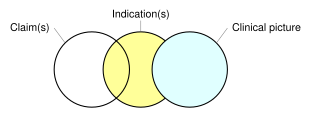
The condition specified in a condition-based indication is not necessarily the clinical picture of the target populations of the device (see Section 5). For example, devices with prediagnostic clinical pictures (see Section 2) target patients with symptoms, signs, and risk factors that suggest the presence of a condition.
Similarly, indications and claims1 can be very different. For example, the manufacturer of the AI system in the example above might claim that the device improves the efficiency of healthcare professionals without affecting the sensitivity or specificity of the diagnosis. However, the indication for the software device remains "provide information used for diagnosis," whereas the performance claim would be "reduce time required by the healthcare professional for diagnosis."
4.2 Procedure-based indications
Whenever a condition-based indication is possible, it should be the preferred approach. However, some devices do not have condition-based indications because their medical purpose is not directed at specific conditions (such as diseases, injuries, or disabilities). Instead, these devices are intended to assist, enable, or perform a medical procedure, regardless of the underlying condition. Many routine, day-to-day medical devices are procedure-based, such as thermometers, intravenous cannulas, or surgical scalpels
Example: Capillary patient thermometer, mercury ( = indication )
An instrument designed to measure a patient’s body temperature […]
Example: Peripheral intravenous cannula ( = indication )
A short, thin tube intended to be inserted into a peripheral vein (typically on the hand/arm) to enable short-term (< 30 days) intravenous (IV) access for administration of fluids/medication and blood sampling […]
However, there are also more complex procedure-based devices, such as cell savers, which are used in surgical settings to recover and reinfuse a patient’s own blood, reducing the need for donor transfusions.
Example: Autotransfusion system ( = indication )
An assembly of devices that includes an electrically-powered aspiration (suction) pump intended to be used to collect, filter, and reinfuse intraoperative and/or postoperative autologous blood shed during and/or after surgery […]
The fact that a device is procedure-based rather than condition-based does not mean it lacks a target population or that its target population (see Section 5) cannot include a clinical picture. For example, an autotransfusion system is intended for adult patients experiencing blood loss exceeding 500ṁl (or more than 10% of their calculated total blood volume) and for children weighing over 10 kg with a blood loss greater than 8 ml/kg (or more than 10% of their calculated total blood volume).
4.3 Devices without a medical purpose
The MDR covers devices that do not have a medical purpose, the Annex XVI devices. These devices require nonetheless an intended purpose. Notice that the MDR readily provides the purposes for most of the classes listed in Annex XVI, these are:
modifying the anatomy or fixation of body parts […]
filling of facial or other dermal or mucous membrane […]
reduce, remove or destroy adipose tissue […]
skin resurfacing, tattoo or hair removal or other skin treatment […]
brain stimulation […]
5 Target population(s)
While it is conceivable to design medical devices without a user (think of a futuristic, fully automated medical system), a medical device cannot exist without a target population. Therefore, after specifying the device indication, the next step is to define the population profile. For those familiar with clinical studies, this part of the intended purpose can be likened to the inclusion criteria of the CIP. There are two aspects of the target population that need specification:
The demongraphics
The clinical picture
Below we consider both aspects in detail.
5.1 Demographics
Demographics can include information such as patient age class (neonates, children, adults, elderly, etc.), gender, weight, height, race, ethnicity, nationality, skin type, marital status, socioeconomic status (e.g., occupation, employment status, income level, education level, housing status, access to healthcared, social support networks, access to transportation, household size and composition, neighborhood characteristics, debt level, etc), cultural background, lifestyle factors (e.g., smoking, alchohol consumption, physical activity), and many more that can affect the ability of a device to achieve its intended performance and safety.
For example, a phototherapy device might be restricted to use in adult patients only. Furthermore, due to its construction, the device might only accomodate patients up to a certain height. This information should be included in the intended purpose demographics specifications:
Example: Phototherapy device ( = Demographics )
A phototherapy device emits UVB and UVA radiation for the treatment of psoriasis in adult patients (maximum height 190 cm) with moderate to severe psoriasis […]
Box 2: Vulnerable populations
Notified bodies will pay particular attention to whether the device’s target patient population includes “vulnerable populations” such as neonates, infants, children, adolescents, disabled individuals, geriatric patients, lactating or pregnant women, etc. If your device addresses one of these populations, you must state it clearly in your intended purpose.
5.2 Clinical picture
The clinical picture specifies the medical conditions, symptoms, or diseases of the target population. There is often confusion regarding the difference between the conditions (disease, injury, disability, processes) specified in the indication and the clinical picture of the target population.
We can consider analyze three cases:
The target population does not include a clinical picture;
The clinical picture is prediagnostic;
The clinical picture is postdiagnostic.
Table 2 summarizes which scenarios are applicable for which indication. Below we analyze each scenario separately.
| Healthy subjects | Prediagnosis clinical picture | Postdiagnosis clinical picture | |
| Diagnosis | ∘ | • | ∘ |
| Prevention | • | • | ∘ |
| Prediction | • | • | ∘ |
| Prognosis | ∘ | ∘ | • |
| Monitoring | ∘ | • | • |
| Investigation | • | • | • |
| Treatment | ∘ | ∘ | • |
| Alleviation | ∘ | ∘ | • |
| Compensation | ∘ | ∘ | • |
| Replacement | ∘ | ∘ | • |
| Modification | • | ∘ | • |
The target population does not include a clinical picture
While all target population specifications include demographic details, not all include a clinical picture. This is because some devices are not intended for a specific medical condition. For example, a thermometer is designed for temperature measurement and can be used on any individual, regardless of their clinical status. However, the target population may still specify whether the thermometer is intended for adults, children, or both based on factors such as usability, accuracy, or safety considerations.
Devices can also target subjects who have not received any diagnosis nor are manifesting symptoms. This can be, for example, the case with devices for prevention. For example:
Example: Lice prevention solution ( = indication )
A liquid substance intended to be applied topically to the scalp and head hair to prevent infestation of human head lice (Pediculus humanus capitis) […]
In this example, the substance is applied before the infestation. The same can occurr with devices for prediction. For example:
Example: Framingham Risk Score ( = indication )
A software device indicated for the prediction of coronary heart disease […]
Such prediction tools are commonly used in screening programs targeting asymptomatic individuals. However, not all devices targeting healthy patients are solely focused on future outcomes. For example, investigational devices can also serve healthy individuals but for immediate assessments. For example:
Example: Pelvimeter ( = indication )
A measuring device used to determine the pelvic dimensions […]
Indeed, a pelvimeter helps healthcare providers determine whether the pelvic dimensions are adequate for a vaginal delivery or if there might be complications that would necessitate a Cesarean section. Alternatively, the anatomy could be modified for esthetic reasons:
Example: Breast implant ( = indication )
A sterile implantable device designed to augment the breast […]
The clinical picture is prediagnostic
Devices intended for diagnosis are used with patients for whom the disease, injury, disability, or condition to be diagnosed has not yet manifested nor has been diagnosed. This means that for devices with diagnostic purposes, the clinical picture is prediagnostic: it cannot include the specific disease, injury, or disability in question. Instead, the clinical picture must list the symptoms, signs, and factors that may potentially lead to these conditions. For example:
Example: Polysomnogram ( = indication; = clinical picture )
A polysomnogram that can be used or at home or in-hospital for diagnosing of sleep apnea. It is indicated for patients with symptoms such as loud snoring, gasping for air during sleep, awakening with a dry mouth, morning headache, difficulty staying asleep, daytime sleepiness, irritability […]
The device is used to detect irregular breathing patterns during sleep that might indicate sleep apnea. Therefore, at the time the device is used, the patient cannot have a diagnosed sleep apnea condition yet. The clinical picture specifies sleep apnea’s symptoms or risk factors (snoring, daytime sleepiness, etc.).
Prediagnostic clinical pictures are not an exclusive of diagnostic devices but can also be the target of devices for prevention, prediction, monitoring and investigation. Let’s consider some examples:
Example: CHA2DS2-VASc score calculator ( = indication; = clinical picture )
A software device indicated for the prediction of stroke. It is indicated in patients with atrial fibrillation […]
This software score calculator is indicated for the prediction of stroke. The device’s purpose is to prevent stroke from occurring. Therefore, at the time the device is used, the patient cannot have developed this condition yet. The clinical picture, instead, specifies another condition (atrial fibrillation) that must have been diagnosed in the patient before a user can utilize the device.
The clinical picture is postdiagnostic
For purposes other than diagnosis, prevention, and prediciton, the clinical picture can be postdiagnostic. This implies that the subject has already received a diagnosis for a condition. In such cases, the clinical picture can provide additional insights into the condition. For instance, it might specify the severity or stage of the condition in more detail. Consider the following examples:
Example: Extracorporeal shock wave lithotripsy device ( = indication; = clinical picture )
A system for the treatment of kidney stones. It can be used with patients with kidney stones of moderate size (smaller than 2 cm), and are located in the kidneys or the upper ureters. […]
5.3 Multiple target populations
Like indications, a device can have several different target populations. The following example includes two distinct patient populations (treatment of psoriasis in adults and treatment of eczema in children):
Example: Phototherapy device ( = demographics; = clinical picture )
A phototherapy device that emits UVB and UVA radiation. The device is indicated for the treatment of psoriasis and eczema. Specifically, the device is indicated for adult patients (maximum height 190 cm) with moderate to severe psoriasis and for pediatric patients (aged 6-17 years) with eczema who have not responded adequately to conventional treatments. […]
The two target populations will require separate considerations for certification (risk management, clinical validation, post-market surveillance, etc.).
5.4 Contraindications and warnings
Contraindications can be though of as the “opposite" of the target population: they specify the demographics and clinical conditions of the patients for whom the device should not be used. For those familiar with clinical studies, this part of the intended purpose can be likened to the exclusion criteria of a clinical investigation.
Box 3: Contraindication vs. complication
Do not confuse contraindications and complications. Contraindications are conditions or factors that serve as reason not to use a medical device with a patient. Complications, on the other hand, are problems or side effects that arise during or after the treatment. Complications are detailed—together with the device risks and side-effects—in the instructions for use.
Consider an example:
Example: Lung-cancer detection AI system ( = indication; = contraindication )
A software AI system intended to provide information which is used for the diagnosis lung cancer […] The device is not applicable for patients who have already undergone significant treatment (e.g., surgery, chemotherapy, radiation therapy) as these treatments can alter the appearance of the tumor and surrounding tissues. […]
In this case, the contraindications outline clinical factors that prevent the use of the device. However, there are situations where you must specify non clinical criteria for not using the device. These criteria are referred to as warnings. Let’s consider an example:
Example: Glucose monitor ( = indication; = warning )
A continuous glucose monitoring system intended for use by individuals with diabetes to monitor blood glucose levels […] The device should not be used to measure glucose immediately after eating (immediate postprandial), as this may lead to innacurate readings. […]
In this case, “immediate postprandial" is neither a demographics characteristic of the patient, nor a clinical condition. However, it is a factor that could affect the reliability of the device.
Box 4: Select the relevant warnings carefully
The intended purpose should only include warnings essential to the device’s application. It should not just list all warnings from the user manual.
6 Intended user(s)
In the intended purpose, you should provide two essential pieces of information concerning the user:
State whether the user is a healthcare professional, a layperson, or both.
State whether the patient is also a user.
If the patient is a user, the intended user must include lay users. Additionally, note that in most countries only healthcare professionals are allowed to emit diagnoses and prognoses. Devices intended to provide information that is used for diagnosis or prognosis must include healthcare professionals as user.
Additional information, such as the user’s type and level of education, and requirements concerning device-specific training, should be provided separately in the instructions for use.
Box 5: Intended user vs. IEC 62366
In the intended purpose, you only need to specify the users who utilize the device to achieve its medical purpose. It is not necessary to list all users, such as those involved in service, maintenance, and cleaning, as required by IEC 62366. Detailed specifications for these additional users can be provided in the instructions for use.
7 Relevant safety and performance information
Indications, target population, contraindications, warnings, and intended users are the essential pieces of information that must be specified for any device’s intended purpose. However, it is sometimes consigliabile to provide additional information relevant to understanding the device-specific application. If you feel uncertain about what to include, here is a tip: refer to the list of design-related requirements in Chapter II of MDR Annex I. If these s highlight a specific characteristic, you should include this characteristic in the intended purpose. Below is a (non-exhaustive) list of characteristics to consider.
7.1 Invasiveness
State if the device is invasive (see MDR Article 2.6) or or surgically invasive (see MDR Annex VIII, Part 2.2).
7.2 Implant
State if the device is implantable (see MDR Article 2.5).
7.3 Personalization
State if the device is custom-made (see MDR Article 2.3). You can also specify whether the device is adaptable or patient-made according to the definition from IMDRF (see IMDRF WG/N58) even though these terms are not directly defined in the MDR.
7.4 Microbial state status
State if the device is provided sterile.
7.5 Reusability
State if the device is single-use or reusable.
7.6 Measuring function
MDCG 2021-24 defines measuring function as follows
The following criteria, if fulfilled together, indicate that a device has a measuring function:
The device is intended by the manufacturer to measure:
quantitatively a physiological or anatomical parameter, or
a quantity or a quantifiable characteristic of energy or of substances (including medicinal products) delivered to or removed from the human body. Spoons or plastic syringes co-packed with medicinal products and used to measure a quantity of that medicinal product to be administered to the patient are in this category. Devices for the delivery of liquid to the human body without graduation or scale (e.g. medicine spoons, cups, droppers without graduation or scale or display of measuring unit) are not in this category.2
The result of the measurement:
is displayed in legal units or other acceptable units within the meaning of Directive 80/181/EEC,3 or
is compared to at least one point of reference indicated in legal units or other acceptable units in compliance with the mentioned directive.
The intended purpose implies accuracy, claimed explicitly or implicitly, where a non-compliance with the implied accuracy could result in a significant adverse effect on the patient’s health and safety.
The expression ‘claimed implicitly’ covers cases where the user, on the basis of the designation of the device or of its accompanying documents, or on the basis of the common use, is entitled to expect accuracy where the accuracy of the measurement has an impact on the diagnosis or therapy of the patient.
Measuring activities during the manufacturing process including those for calibration purposes are not covered and do not imply a measuring function of the manufactured device.
7.7 Substances
Devices incorporating or consisting of substances
State whether the device incorporates or consists of:
Medicinal products (including substances derived from human blood, or huma plasma)
Non-viable tissues or cells, or their derivatives, of human origin
Non-viable tissues or cells, or their derivatives, of animal origin
Other non viable substances of biological origins (e.g., bacteria, fungi, viruses)
Gases
Latex
Nanomaterials
Substances which are carcinogenic, mutagenic or toxic to reproduction
Substances having endocrine-disrupting properties
Other substances (specifies)
Absorbed and dispersed substances
State whether the device is composed of substances (or combinations of substances) that are introduced into the body or applied to the skin, and that are absorbed by or locally dispersed in the body. These substances can include:
Non-viable tissues or cells, or their derivatives, of human origin
Non-viable tissues or cells, or their derivatives, of animal origin
Other non viable substances of biological origins (e.g., bacteria, fungi, viruses)
Gases
Other substances (specify)
Administered substances
State whether the device administers:
Medicinal products (including substances derived from human blood, or huma plasma)
Non-viable tissues or cells, or their derivatives, of human origin
Non-viable tissues or cells, or their derivatives, of animal origin
Other non viable substances of biological origins (e.g., bacteria, fungi, viruses)
Gases
Other substances (specifies)
Removed substances
State whether the device removes any of the following substances from the body:
Medicinal products (including substances derived from human blood, or huma plasma)
Non-viable tissues or cells, or their derivatives, of human origin
Non-viable tissues or cells, or their derivatives, of animal origin
Other non viable substances of biological origins (e.g., bacteria, fungi, viruses)
Gases
Other substances (specifies)
7.8 Radiation
State whether the device emits radiation for medical purposes and specify the radiation type (UVA, UVB, UVC, infrared, ionising, etc.).
7.9 Energy supplied to the patient
State whether the device supplies energy to the patient and specify the energy type (e.g., electrical, magnetic, mechanical, thermal, acoustic, etc.).
7.10 Power supply
State whether the device has an internal power supply and its type (e.g., disposable batteries, rechargeable batteries, etc.). State whether the device has an external power supply and its type (e.g., AC mains, DC, USB, wireless, etc.).
7.11 Compatibilities
Specify whether the device is intended for use in combination with other devices or equipment, or within a specific medical procedure.
References
-
IEC 62366 — Medical Devices – Application of Usability Engineering to Medical Devices. IEC, 2015
-
IMDRF WG/N47 — Essential Principles of Safety and Performance of Medical Devices and IVD Medical Devices. IMDRF, 2021
-
IMDRF WG/N58 — Personalized Medical Devices. IMDRF, 2020
-
IMDRF WG/N9 — Non-In Vitro Diagnostic Device Regulatory Submission Table of Contents (nIVD ToC). IMDRF, 2024
-
MDCG 2019-11 — Guidance on Qualification and Classification of Software in Regulation (EU) 2017/745 – MDR and Regulation (EU) 2017/746 – IVDR. MDCG, 2019
-
MDCG 2020-6 — Regulation (EU) 2017/745: Clinical evidence needed for medical devices previously CE marked under Directives 93/42/EEC or 90/385/EEC. MDCG, 2020
-
MDCG 2021-24 — Guidance on classification of medical devices. MDCG, 2021
-
MDCG 2022-9 — Summary of Safety and Performance Template. MDCG, 2024
-
MDR — Regulation (EU) 2017/745 on medical devices. European Parliament and Council of the European Union, 2024