1 Introduction
2
This series of articles on systematic searches and reviews seeks to address the gap left by current regulations and standards within the EU and globally. The lack of harmonization and guidance has led companies to adopt vastly different approaches, often resulting in wasted effort and resources on strategies that are impractical, ineffective, and still fall short of regulatory requirements.
One significant challenge lies in the widespread perception that systematic searches and reviews are primarily tied to clinical evaluation. This misconception likely originates because it was MEDDEV 2.7/1 that introduced these methodologies to the medical device field. As a result, many view systematic searches as a single, monolithic task—the literature search—meant to address all requirements in the technical documentation.
In reality, systematic searches and reviews are the underpinning of a wide range of regulatory processes, including state of the art analyses, research and development, risk management, and post-market surveillance.
Box 1: Search vs. review
The terms "systematic search" and "systematic review" are not synonymous. A systematic review begins with a systematic search and then summarizes the results of the search qualitatively or quantitatively. For the technical documentation of your device, you will need both approaches.
Indeed, a technical documentation will typically require multiple searches and reviews (see Box 1). These typically include at least the following systematic searches:
Post-market searches,
Applicable regulations,
Applicable standards,
Applicable guidance, and
Market analysis.
and the following systematic reviews:
Medical background, and
Performance and safety of interventions.
From the above list, it should be evident that different searches and reviews serve distinct purposes. Unfortunately, this distinction is often misunderstood. For example, a common misconception is that all systematic searches in a technical file must be fully reproducible or exclusively include the highest levels of evidence. In reality, each search is designed with specific goals in mind, uses tailored search strategies, and targets different levels of evidence. For instance, post-market literature searches—discussed in detail in this document—prioritize breadth over reproducibility or level of evidence.
Post-market searches are literature searches (see Box 1) aimed at identifying written information concerning the performance or safety of a specific medical device. These searches are also referred to as "PMCF" or "PMPF" searches. Indeed, under MDR and IVDR post-market searches are considered PMCF and PMPF general activities (MDR, Annex XIV, Part 6.2(a) and 6.2(f), IVDR, Annex XIII, Part 5.2(a) and 5.2(f), and MDCG 2020-7).
Box 2: Literature search
The term "literature search" is sometimes interpreted as synonymous with "search in scholarly articles". This interpretation is incorrect. As explained in MEDDEV 2.7/1, Appendix A4, literature searches encompass any body of written work or documentation relevant to a particular research topic, which may also include internet searches and non-published data.
The fact that post-market searches are post-market activities does not mean that they must be conducted only after certification. On the contrary, manufacturers should start post-market searches concerning devices that are already on the market before starting certification and in parallel with state of the art analyses. Indeed, post-market searches don’t just target the device under evaluation, but also legacy, similar, and equivalent devices (see Box 1 for an explanation of these terms).
The most efficient way to organize post-market searches is by producing a separate literature search protocols/reports for each device, including all its variants. If the device belongs to a device family1, we recommend conducting separate searches for each device in the family. This approach allows maximizing clarity as well re-usability of the work, since the same report can be referenced in different processes.
Post-market searches are systematic searches. This means that they must be planned, conducted, reported, and updated according to best practices. Below, we outline these best practices. In section 6 we provide examples of uses of data from post-market searches.
Box 3: Device under evaluation, legacy, similar, and equivalent devices
The expression "device under evaluation" is not defined in the MDR, but it is used in MEDDEV 2.7/1 to denote the device that is being evaluated for conformity.
According to MDCG 2020-6, "legacy device" is any device all devices previously CE marked under MDD or AIMDD. In practice, the term is typically used during certification of a device under evaluation to denote a device from the same manufacturer, bearing the same name, and CE marked under MDD or AIMDD. The device under evaluation and its corresponding legacy device are two distinct devices, even when they are technically identical. This distinction arises because, from a regulatory perspective, a device is not only the physical or software component but also the entirety of the device’s documentation and informational materials, which include its certification.
According to MDCG 2020-6, "similar device" is any device belonging to the same "generic device group", which, according to MDR, Article 2.7, is the set of devices having the same or similar intended purposes or a commonality of technology allowing them to be classified in a generic manner not reflecting specific characteristics. MDR Annex II, Part 1.2(b) specifies that a similar device can be available on the Union or international market.
Equivalent device is a device against which the manufacturer has demonstrated equivalence of the device under evaluation according to the rules specified in MDR Annex XIV, Part 3, and explained in MDCG 2020-5
2 Planning the search
2
This chapter outlines the key elements to consider when planning a post-market search. These include defining objectives, selecting sources, developing a search strategy, and establishing appraisal criteria. For additional guidance on planning systematic searches and reviews, you may refer to the PRISMA checklist2.
2.1 Evaluators
Specify who will perform the post-market search. The definition of specific roles (such as author, reviewer, approver, etc.) typically depends on company-specific procedures.
The requirements of MEDDEV 2.7/1 concerning the expertise of clinical evaluators also applies to post-market searches. These requirements include knowledge of:
research methodology (including clinical investigation and biostatistics);
information management;
regulatory requirements;
medical writing;
the device technology and its applications;
-
diagnosis and management of the conditions intended to be diagnosed or managed by the device, knowledge of medical alternatives, treatment standards and technology.
In addition, evaluators must possess a relevant degree from higher education in the respective field and 5 years of documented professional experience, or 10 years of documented professional experience if a degree is not a prerequisite for the given task.
2.2 Objectives
The objective of post-market searches is to gather any written record that provides information about the performance and safety of a particular medical device. Post-market searches are systematic searches, not reviews (see Box 1). Their goal is to identify information about the device, not to draw conclusions from cumulative evidence. Analysis and synthesis occur later in processes like clinical evaluation or post-market surveillance (see Section 6).
Instead, once identified, each record should be assessed for information about the following aspects concerning the device (see MDCG 2023-3 for a definition of these concepts):
Performance or benefit
Underperformance
-
Deterioration in the characteristics or performance (including underperformance and performance/safety issues in sub-populations)
Hazards, hazardous situations, or risks
Malfunctions
Expected undesirable side effects (MD)
Unexpected undesirable side effects (MD)
Expected erroneous results (IVD)
Unexpected erroneous results (IVD)
Use errors
Abnormal use (including off-label use)
Inadequacies in the information material
These aspects can be directly translated into specific search questions. For example, you might ask Does the record report data concerning the performance or benefit of the device? or Does the records report malfunctions or unexpected undesirable side effects of the device? Framing search questions around each aspect helps ensures that you capture of all relevant information.
2.3 Source selection
The focus of post-market searches is on uncovering as much information as possible on a device. This means that finding relevant evidence takes priority over ensuring the rigor or reproducibility of the source. As a result, post-market searches may include sources with limited or no reproducibility, such as search engines like Google Scholar or manufacturer websites. Indeed, once relevant evidence is identified, the source becomes less important than the fact that the evidence has been found.
Below is a minimum list of source types that post-market searches should rely on:
Sholarly articles
Clinical trials registries
Safety information databases
Patient registries
Websites
Below, we will consider each source type in detail.
2.3.1 Scholarly articles
The term "scholarly articles" refers to publications authored in academic settings. It is standard practice to start with cross-publisher sources when conducting searches, as they save time by gathering content from a wide range of publishers in one place.
Cross-publisher sources
Scholarly sources do not all operate in the same way. For instance, popular sources—for example, PubMed—do not index the full text of articles. Other sources—for example, PMC—may limit searches to open-access material. Furthermore, not all scholarly sources—for example, Google Scholar—are databases.
For this reason, we recommend a search strategy that combines these different sources. Below, we outline this search strategy in detail, starting with a classic in the field: PubMed.

PubMed is the most widely recognized medical literature database in the world and is often the go-to starting point for literature searches. However, PubMed only indexes titles and abstracts, which means it cannot retrieve search terms within the full text of articles. Therefore, while it is a great source to begin a search, relying solely on PubMed will likely result in missing a significant amount of relevant information.
The challenge with PubMed is that most studies documenting the use of a device in practice do not include the device’s name in their title or abstract. Typically, only studies focused specifically on evaluating a device’s performance and safety, or studies explicitly designed to test the device, mention its name so prominently. In contrast, most studies that involve a device in routine practice treat it as a secondary element and mention the device’s name in the methods section. Fortunately, the National Library of Medicine offers a solution to this issue through PubMed’s "smaller sibling," PMC.

PMC complements PubMed by indexing the full texts of articles, thus overcoming one of PubMed’s major limitations. PMC thus provides more comprehensive search results by allowing access to the body of the articles. However, PMC only indexes open-access articles, which limits the scope of available literature.
Additionally, the European Bioinformatics Institute, provides a resource similar to PMC with expanded coverage of open-access articles and European-funded research.

Europe PMC enhances your literature search by increasing coverage of European journals. Like PMC, it indexes full texts, but it is also limited to open-access articles. While this database adds valuable geographic diversity, it still shares PMC’s limitations. Therefore, it is useful to include it in your search but not sufficient on its own.
A common limitation of PMC and Europe PMC is that they primarily index open-access articles. To overcome this issue, we can utilize databases that also index closed-access articles, with OpenAlex being one of the most accessible and user-friendly options.

OpenAlex, launched in January 2022, serves as a successor to the discontinued Microsoft Academic Graph (MAG). It indexes a vast array of scholarly works, encompassing both open-access and millions of closed-access articles, thereby significantly broadening the scope of research searches. OpenAlex offers a user-friendly interface and provides full control over searches, including comprehensive export options and an accessible API.
The sources discussed above are "databases," which enable reproducible searches through structured indexing, advanced filtering options, and change histories. These features ensure that identical queries consistently yield the same results. In contrast, "search engines" are a different type of source. Their searches are not reproducible because results vary between users, and the underlying algorithms are often opaque.
You might wonder why using search engines is still relevant. The answer is simple: the largest scholarly database in the world is, in fact, a search engine.

Google Scholar is the largest scholarly resource worldwide, indexing the full texts of hundreds of millions of articles, both open- and closed-access. However, unlike structured databases, Scholar functions as a search engine. This means it relies on a proprietary algorithm, making searches difficult to reproduce, and it lacks a robust export interface for systematic reviews. Despite these limitations, its vast coverage makes it a invaluable tool for comprehensive searches, especially for post-market queries when you’re desperate to uncover even the smallest piece of relevant data.
Publisher-specific sources
Once you’ve completed your search in aggregated databases, you can turn to publisher-specific platforms. Most publishers offer platforms that allow full-text searches within their published journals. If you are aware that a specific journal or publisher is particularly likely to publish relevant data on the device you are researching, consider supplementing the aggregated database search with searches in the specific publisher’s databases.
2.3.2 Clinical trials registries
A clinical trials registry is a publicly accessible database where information about clinical trials, including clinical investigations involving medical devices, is stored and made available to the public.
Manufacturers are usually aware of most investigations studies involving their devices, either because they are the sponsors or, in the rare case of investigator-initiated trials, the investigator has informed them. However, searching clinical trial registries can help manufacturers uncover studies where their devices are used not as the primary subject of the investigation, but as part of the study. For post-market searches, these databases are particularly valuable, as they allow manufacturers to identify ongoing studies or those without published results that involve their devices.
Almost every country has its own clinical trial registry. These can range from something as simple as an Excel file stored on the servers of an institution to comprehensive platforms like ClinicalTrials.gov. Fortunately, the WHO has consolidated most of this information into ICTRP. ICTRP is a global initiative that compiles data from multiple registries. This makes it easier for researchers, healthcare professionals, and the public to access comprehensive information about ongoing and completed clinical trials. Using of ICTRP is recommended in MEDDEV 2.7/1.
2.3.3 Safety information databases
The terms "safety information" or "safety" database are used to describe databases maintained by national authorities that store safety-related information on medical devices. This safety information can be very heterogeneous and includes incidents/adverse events from the field, field safety notices and corrective actions (e.g., recalls) from manufacturers, as well as alerts, bans, and recommendations from the authorities themselves. Some competent authorities maintain separate databases for different types of information, while others provide a unified platform. IMDRF maintains a list3 of these databases from the competent authorities of its member states.
Several misunderstandings often surround safety databases and their use. For example, these databases are sometimes misused to demonstrate the safety and performance of a device. However, as TGA states in its DAEN adverse event database, this information:
-
[…] cannot be used to determine the incidence of an adverse event (that is, how often the adverse event has occurred in users of a particular medical device), or the likelihood of a user experiencing that adverse event […].
-
[…] cannot be used to make accurate numerical comparisons between adverse events associated with different medical devices.
-
[…] does not include information about the benefits of the medical device, so the search results cannot be used to determine if the benefits of using the medical device outweigh the risks.
-
[…] provides limited information about the severity of the adverse events, the duration of use of the medical device and/or the maintenance of the medical device.
FDA provides similar recommendations for MAUDE:
[…] this passive surveillance system has limitations. The incidence, prevalence, or cause of an event cannot be determined from this reporting system alone due to under-reporting of events, inaccuracies in reports, lack of verification that the device caused the reported event, and lack of information about frequency of device use. Confirming whether a device caused a specific event can be difficult based solely on information provided in a given report. Establishing a causal relationship is especially difficult if circumstances surrounding the event have not been verified or if the device in question has not been directly evaluated.
Another misconception is that manufacturers need to conduct searches in safety databases for their devices. This is flawed because manufacturers are typically notified by authorities about incidents, alerts, or bans related to their devices, and they typically issue safety notices or corrective actions themselves. Thus, manufacturers are usually already aware of most data about their devices in these databases.
So what can these databases be used for? As emphasized in MEDDEV 2.7/1, Appendix A4, safety databases are primarily useful for the equivalent and/or other devices. These databases can provide insight into risks associated with similar devices or. In our upcoming guide on the systematic review on performance and safety of intervention we will see how these databases can also be used to identify risks and side effects of generic device groups. For example, you would not want to use as equivalent device, a device that has been recalled from the market.
Box 4: Regions
Which safety databases should you query? Focus on the databases relevant to the regions or countries where the device you are researching is sold.
Safety databases can broadly be classified into two groups. The first group provides incident and adverse event reports that are typically reported by third parties such as healthcare professionals, patients, or clinical facilities. The second group includes actions (field safety notices, alerts, field safety corrective actions, recalls, bans) initiated by manufacturers or competent or regulatory authorities. Below, we analyze the two groups separately.
Incidents and adverse events
While the exact definition of incident/adverse event varies across regions, these terms generally refer to situations where the use of a medical device has or may have caused or contributed to a death or serious injury of patients, users, or others. One interesting aspect of incident/adverse event reports is that they may originate directly from users. This distinguishes them from the actions initiated by manufacturers or authorities, which we discuss in the next section. Instead, many reports come from healthcare professionals, patients, or other users of the devices. Manufacturers are typically notified by authorities about third-party reports.
| Authority | Database Name | |
 |
FDA | Manufacturer and User Facility Device Experience |
 |
TGA | Database of Adverse Event Notifications* |
 |
Health Canada | Medical Device Incident Database |
Table 2.1: Databases of incidents and adverse events reports. (*At the time we are writing—December 2024—’s appears to be affected by huge performance and usability problems.)
Not many institutions make reports on incidents or adverse events with medical device accessible. Currently we are aware of three sources of incidents/adverse events reports, Table 2.1. EUDAMED is expected to release a vigilance module in which the serious incidents involving devices made available on the European Union market will be (partially) made available to the public.
Box 5: MAUDE, OpenFDA, TPLC
FDA provides adverse event reports via MAUDE and the OpenFDA API. In theory, the results in the two databases should match. Surprisingly, in practice, they often don’t (FDA is aware of this issue
. For a complete search, make sure to compare the results from both sources.
The TPLC database provides an overview of a medical device’s regulatory history throughout its entire life cycle, from premarket development to post-market surveillance. It integrates data from varioFDA sources, including premarket approvals, 510(k) clearances, recalls, adverse events (from MAUDE), and other regulatory activities.
TPLC organizes information by "Devices" or "Product Codes," which represent groups of devices with similar characteristics—not specific brand names.
As a result, TPLC is not suitable for post-market searches focused on specific brands. However, it may be useful for State of the Art SOTA analysis if the FDA’s product code definition is sufficiently narrow to ensure relevance to the device group being reviewed. Unfortunately, this is often not the case.
Actions by manufacturers or authorities
Several databases store records of actions taken by manufacturers or authorities regarding specific devices, including field safety notices, field safety corrective actions, recalls, bans. Table 2.2 provides an overview of these databases.
| Authority | Database Name | |
| Europe | ||
 |
MHRA | Alerts, Recalls and Safety Information |
 |
BfArM | Field Corrective Actions |
 |
ANSM | Informations de Sécurité |
 |
BASG | Official Announcements |
 |
ΙΥ&ΥΔΥ | Ειδοποιήσεις Ασφαλείας/ Επαγρύπνησης |
 |
SÚKL | Registr zdravotnických prostředků |
 |
DKMA | Sikkerhedsmeddelelser fra fabrikanter af medicinsk udstyr |
 |
MdS | Avvisi di sicurezza sui dispositivi medici |
 |
Infarmed | Alertas |
 |
AEMPS | Notas informativas Productos sanitarios |
 |
IGJ | Waarschuwingen van fabrikanten medische hulpmiddelen |
 |
LV | Nyheter och säkerhetsnyheter |
 |
Swissmedic | FSCA |
Table 2.2: Databases of actions initiated by manufacturers or authorities (continues on the next page).
| Authority | Database Name | |
| North America | ||
|
FDA | Safety Communications |
|
FDA | Medical Device Recalls |
|
FDA | Medical Device Bans |
|
FDA | Letters to Health Care Providers |
|
Health Canada | Recalls and Safety Database |
| Asia | ||
 |
PMDA | Safety Information |
 |
HSA | Announcements |
| South America | ||
 |
ANVISA | Alertas |
|
ANVISA | Consultas |
| Oceania | ||
|
TGA | System for Australian Recall Actions |
Searching these databases can be challenging due to their heterogeneity. First, the terminology used to describe different types of actions varies across databases. For instance, Health Canada uses the term "recall" to refer to “any action taken by the manufacturer, importer, or distributor of a sold device to recall or correct the device, or to notify its owners and users of its defectiveness or potential defectiveness.”
Second, the technology and formats used across and even within databases can differ significantly. For example, the UK’s MHRA stores field safety notices since 2020 in an Excel table, those issued between 2014 and 2020 on a cloud storage, and those prior to 2014 in the National Archives. This lack of standardization can make navigating these databases time-consuming and complex.
Third, the safety information are sometimes stored in non-searcheable PDFs.
2.3.4 Patient registries
Several patient registries are available for specific device groups or medical procedures, but access to the data within these registries is often restricted to third parties. In certain cases, it is possible to request specific analyses from these registries, though this is typically grantedon a case-by-case basis. Unfortunately, no comprehensive list of all patient or produce registries is available.
2.3.5 Websites
Below, we review websites recommended for conducting post-market searches.
Author websites
Research groups at university and research institute tend to use the same search setup over and over. If you identify a lab that published an article featuring your device, you should consider reviewing the whole list of publication on the authors webiste, in particular the principa investigator page, or even consider contacting them to ask if they have published more data that were collected when your device was used.
Manufacturer websites
Particularly when researching similar or equivalent devices produced by third parties, it is suggestable to review their website. Often manufacturer make available on their website data that has not been published in journals etc.
App stores
Manufacturers of medical apps should retrieve and analyze the reviews left on the app stores concerning their products, to identify possible problems.
2.3.6 Hand search
Hand searching is a practice that originated in the era when researchers manually sifted through physical sources in libraries. Today, searches are typically conducted online, making it essential to specify where a record was located. While hand searching may still have a role in some cases, it is generally advisable to limit its use and rely on more transparent and reproducible search methods.
2.3.7 Which sources you don’t need
Post-market searches typically gain little from including systematic reviews and meta-analyses, such as Cochrane’s CDSR or PROSPERO. Indeed, it is uncommon for a review to focus on a specific device or mention one in detail. A notable exception is when the device under evaluation or the similar device can be considered a benchmark in the field. Similarly, searches within professional medical associations and health technology assessments (HTAs) can typically be skipped.
In the market, you’ll find plenty of paywalled databases claiming to deliver more relevant results for device searches. However, in our experience, these sources often fall short compared to the freely available ones we highlighted in the search strategy above. A CE mark can be achieved successfully without relying on these paywalled options.
2.4 Search strategy
Post-market searches aim to identify any written information concerning a specific device. For this reason, the search strategy should be as broad as possible, while remaining manageable. Below are the key steps.
2.4.1 Inclusion criteria
PICO strategies are not suited for post-market searches. This is because PICO strategies are applied when the intervention and outcomes are predefined. However, the objective of a PMCF search is broader: to capture all literature related to a specific device, including off-label uses and unexpected outcomes. Using a PICO approach here may exclude relevant information by focusing too narrowly on predefined criteria.
Indeed, post-market searches have only one inclusion criterion, namely, that the identified record provides information about the performance or safety of the device for which the search is conducted.
2.4.2 Queries
Aim to use as few terms as possible in the search query to maximize retrieval. You can start with the device name alone. However, many medical devices have names that can easily be confused with other terms commonly used in the medical literature. In such cases, it is advisable to include the manufacturer’s name in the query.
If the device belongs to a family of devices, you can consider searching the for the family name and restricting the results to the specific device during the screening.
If the device or manufacturer have undergone name changes over time, ensure that all previous names are included. If you want to be as comprehensive as possible, also consider including possible name misspellings and transliterations in non-Latin alphabets.
2.4.3 Limits and filters
Post-market searches are typically conducted with an "open filter" approach, meaning no filters are applied. All levels of evidence are considered suitable for retrieval, including non peer-reviewed information. However, you may restrict the search time period to start after a specific date, if you are certain that the device was not marketed anywhere in the world prior to that date.
2.4.4 Exclusion criteria
For post-market searches, we recommend using a one-steps screening (full-text screening). This is because most records that document the use of a device in routine practice treat it as a secondary element and often do not reference it in the title or abstract. The only exclusion criterion is that the record does not provide information regarding the performance or safety of the device.
2.5 Appraisal
Post-market searches gather evidence concerning the performance and safety of a medical device. This evidence is then analyzed in various processes, such as clinical evaluation, post-market surveillance, post-market clinical follow-up, risk management, and more. Due to the different purposes for which the data will be used, the appraisal of the identified evidence occurs within the processes tailored to each specific objective, rather than during the search itself. For example, in the clinical evaluation you will appraise the clinical data that you will take from the device specific search forthe clinical evaluation using the IMDRF system.

Create successful post-market searches even with no regulatory expertise. Follow the "review wizard", answer the questions. Evidence will automatically generate the full review plan, including objectives, search questions, inclusion and exclusion criteria, and appraisal plan. But that’s not all—Evidence goes a step further by automatically conducting proposed searches across relevant scholarly, clinical trials, and safety information databases. Simply review the plan, lock it, and shift your focus to the science. No matter your level of regulatory expertise, Evidence ensures you’ll get it right.
| Post-market searches (this document) | Medical background SOTA (SOTA_BACKGROUND) | |
| Type | Systematic search | Systematic review |
| Objectives | Gather any written record that provides information about the performance and safety of a particular medical device. | The objective of medical background SOTA analyses is to provide an objective, unbiased overview of standard medical practice concerning a specific condition or procedure. |
| Source Selection | ||
| Scholarly article databases |
|
|
| Publisher specific | Ad hoc | Ad hoc |
| Clinical trials | ICTRP | Rarely required |
| Health technology assessments | Rarely required | |
|
Incidents and adverse events |
|
Rarely required |
|
Actions by manufacturers and authorities |
Database of any authority in countries in which the devices is sold | Rarely required |
| Patient registries | Ad hoc | Rarely required |
| Websites |
|
|
| Use of handsearch | May be acceptable: reporting evidence has priority over how evidence is found. | Not acceptable |
| Systematic reviews | Rarely required |
|
|
Paywalled databases (e.g., Embase, Scopus, Web of Science) |
Not required | |
| Search Strategy | ||
| Inclusion criteria | Any record that reports information concerning the performance or safety of the device (in humans) | PICO strategy |
| Queries |
|
Condition or procedure name(s) |
| Time limits | From date device was brought onto the market to search date | Last 5, 10, or 20 years, depending on field update frequency. |
| Peer review | Records do not need to be peer-reviewed | Records must be peer-reviewed |
3 Conducting the search
2
This chapter outlines the key elements to consider when conducting a post-market search. These include collecting all database information such as search details and search results, retrieving missing information, screening and data extraction. Below we review each element in detail.
3.1 Search details
For each query in each source, provide as much relevant information as possible. This should include:
The source name and link
The original search query
-
The actual search conducted by the database (including any automatic modifications or expansions to the terms)
Any filters applied (e.g., publication type)
Any limits or restrictions (e.g., date range)
The name of the person who performed the search
The date and time the search was conducted
Box 6: Searches with no results
The fact that a search returns no hits is an information on its own. You should document it to show to reviewers why a search strategy didn’t provide results.
3.2 Search results
Document all records identified during database searches. For search engines—such as Google Scholar (see Section 2.3.1 for a difference between database and search engine)—you don’t need to import all results. Instead, you can either select specific items to import or limit it to a certain number of pages.
Make sure the metadata are complete for all retrieved records, even for those you already plan to exclude. These should include:
-
Full citation details (e.g., title, authors, journal, volume, issue, page numbers, year, report number, study number)
-
Any further information required to uniquely identify the record (e.g., incident number or trial identifier)
-
The abstract of scholarly articles (some scholarly articles does not provide an abstract, you should note this information in the documentation)
The text of all records that you scan on full text.
You can retrieve missing metadata by cross-verifying with other databases or the publisher’s website.
3.3 Deduplication
Before processing the records you must identify duplicates. While this may seem straightforward, there are several common misconceptions about the process (see also Box 3.3). Finding duplicates involves identifying instances where the same record appears across different searches within the same source or from multiple sources. However, this task is more complex than it seems, as the same record may be represented with different metadata in different sources. It’s important to note that for one record to be considered a duplicate of another, it must represent the exact same full text. For instance, a preprint is not a duplicate of the corresponding journal-published article, as editorial changes may have occurred during final publication.
Box 7: Duplicated records vs. duplicated data
It is not uncommon that researchers publish the results of a single study across multiple publications. In the terminology of the PRISMA 2020 flow diagram, this is described as multiple reports corresponding to the same study (see also box 4.1.3). Some may refer to this situation as "duplicated data," but it is important to clarify that two distinct publications based on the same dataset are not considered duplicate records.
3.4 Translation
Translate relevant non-English documents for inclusion in the analysis. Ideally, translations should be performed by a field expert proficient in both languages. However, in practice, notified bodies in Europe currently accept automated translations.
3.5 Screening
For each identified record, clearly indicate whether the record is included or excluded based on the exclusion criteria outlined in Section 2.4.4. For each excluded record, document the specific exclusion criterion applied.
3.6 Full text
You are expected to retrieve the full text of all records that you include during the screening. For two-step screening (first screening on title and abstract, followed by screening on full text) you should also make available the full text of the records that were excluded during the second (full-text) screening step.
3.7 Contact the authors
Some information may be missing from the retrieved record. For example, articles often fail to clearly specify the model or variant of a device family or device, and details about the reported data may sometimes be unclear. In such cases, consider reaching out to the author of the article, field safety notice, or incident report. While responses are not guaranteed and may be rare, it is worth attempting to obtain clarification.
3.8 Citation search
The process of including records in the search does not end with the imports from the sources. For each record included during screening, you are expected to review the references cited within those articles (see MEDDEV 2.7/1, Section A4). This is because literature found to be relevant is likely to cite other literature that is of direct interest to the manufacturer.
Indeed, even the PRISMA 2020 flow diagram (see also Section 4.1.3) provides a dedicated space for documenting records retrieved through citation search.
3.9 Data extraction
For each question defined in the objectives of your literature search plan (see Section 2.2), extract the information pertaining to that question from each record included in the screening. Document when a record does not provide information for a specific question.
If the record is a study report (see Box 4.1.3) it is best practice to extract basic study information for future retrieval. These include study characteristics such as country, number of sites, study direction, type (interventional or observational), design, inclusion and inclusion criteria, primary and secondary outcomes, follow-up and main results.
3.10 Complaints reporting
If during data extraction you identify any information suggesting deficiencies in the identity, quality, durability, reliability, safety, effectiveness, or performance of the device under evaluation, report this information to your company’s complaint management department in accordance with your company procedures.
Save hundreds of hours of tedious work. Evidence automatically captures queries, search date, search details, filters, and limits from your searches in PubMed, Google Scholar, PubMed Central (PMC), Europe PMC, OpenAlex, Cochrane, Prospero, ICTRP, MAUDE, DAEN, MDID. It also automatically imports the search results and works in the background to retrieve missing metadata, including titles, authors, abstracts, journals, etc. Evidence then automatically identifies duplicates and downloads the full text of open-access articles. But it doesn’t end here Evidence provides suggestion for the screening and automatically extracting study characteristics and answering the questions of your search objectives using the information from the full texts (coming January 2025).
4 Reporting the search
2
Reporting the search can be one of the most tedious and time-consuming tasks in systematic searches and reviews, especially when it comes to managing screening details and summaries. Below, we briefly outline the key principles for documenting post-market searches.
4.1 Reporting the screening
To ensure total clarity, in the search report, you should include three types of screening summaries, each presented at a different level of granularity:
screening summary for each query in each source;
screening details for each item retrieved in the search;
-
a flow diagram overview of the screening for the totality of the records imported in the systematic search (see Section 4.1.3).
below we analyze each report in detail.
4.1.1 Screening report
Begin the screening summary by providing the reviewer with an overview of the different queries across the various sources. For each query in each source, include the following details:
The total number of records retrieved from the query.
The number of records that were ultimately included after screening.
The total number of records excluded during the screening process.
A detailed count of records excluded under each specific exclusion criterion.
4.1.2 Screening detail for each item
Provide detailed screening information for each item retrieved in the search, including the specific exclusion criteria applied. To streamline the review process, display the screening details alongside basic record information, such as the title, authors, and abstract/summary. This approach allows reviewers to quickly sample and verify your screening without needing to search for the information separately.
4.1.3 Flow diagram
The PRISMA 2020 flow diagram4 is designed to summarize the retrieval and screening of studies (see Box 4.1.3). Therefore, in its original form, the PRISMA 2020 flow diagram is not suited for documenting post-market searches that include records other than studies, such as incidents or other non-study reports. For PMCF searches, we thus suggest using a modified version of the PRISMA 2020 flow diagram that takes only records into consideration.
Box 8: Record, report, study
The PRISMA 2020 guidance5 clarifies the difference between record, report and study.
Record—The title or abstract (or both) of a report indexed in a database or website (such as a title or abstract for an article indexed in Medline).
Report—A document (paper or electronic) supplying information about a particular study.
Study—An investigation, such as a clinical trial, that includes a defined group of participants and one or more interventions and outcomes. A “study” might have multiple reports.
Results from search engines such as Google Scholar (see Section 2.3.1), from citation searches (see Section 3.8), and from websites (see Section 2.3.5) should be documented under the "Identification of studies via other methods" part of the diagram.
4.2 Reporting the data
Ensure full transparency. Report every aspect of the data extraction for each included record. This includes the information extracted for each question outlined in the search objectives, study characteristics, and—if applying appraisal—the appraisal details for each record.
Generate a submission-ready literature search protocol with just one click. Once screening and data extraction are complete, your work is done. Why waste time with clunky Excel tables or corrupted Word files? Simply download the protocol, sign it, and send it to your notified body. And don’t worry—Evidence organizes all full texts seamlessly, ensuring reviewers can easily follow every step.
5 Updating the search
2
The work of conducting post-market searches does not stop with market approval. These searches must be continuously updated through regular intervals as part of post-market surveillance activities. Below we explain when, how, and how long you should be updating your post-market searches.
5.1 When to update
You must update the search in conjunction with the PMCF report. In turn, the PMCF report needs to be updated whenever any of the processes relying on PMCF data—such as the clinical evaluation or the PSUR—is revised.
At a minimum, updates are required to align with the updates to the clinical evaluation and PSUR, which should ideally be synchronized. According to the MDR, Article 86, and IVDR, Article 81, these updates must occur at least annually for high-risk devices. For other devices, updates may be less frequent but should still adhere to a periodic schedule defined by the manufacturer based on the risk classification and intended use of the device.
5.2 How to update
A common misconception about search updates is that using the "delta" approach is sufficient. This method involves updating a search by retrieving only the results published after the date of the last search. However, this approach is flawed because it overlooks how databases operate. Records are often added to databases with significant delays, meaning that older records can be added after the last search was completed. If your search update starts from the last date of your search, you will miss these results, as illustrated in Figure 5.1.
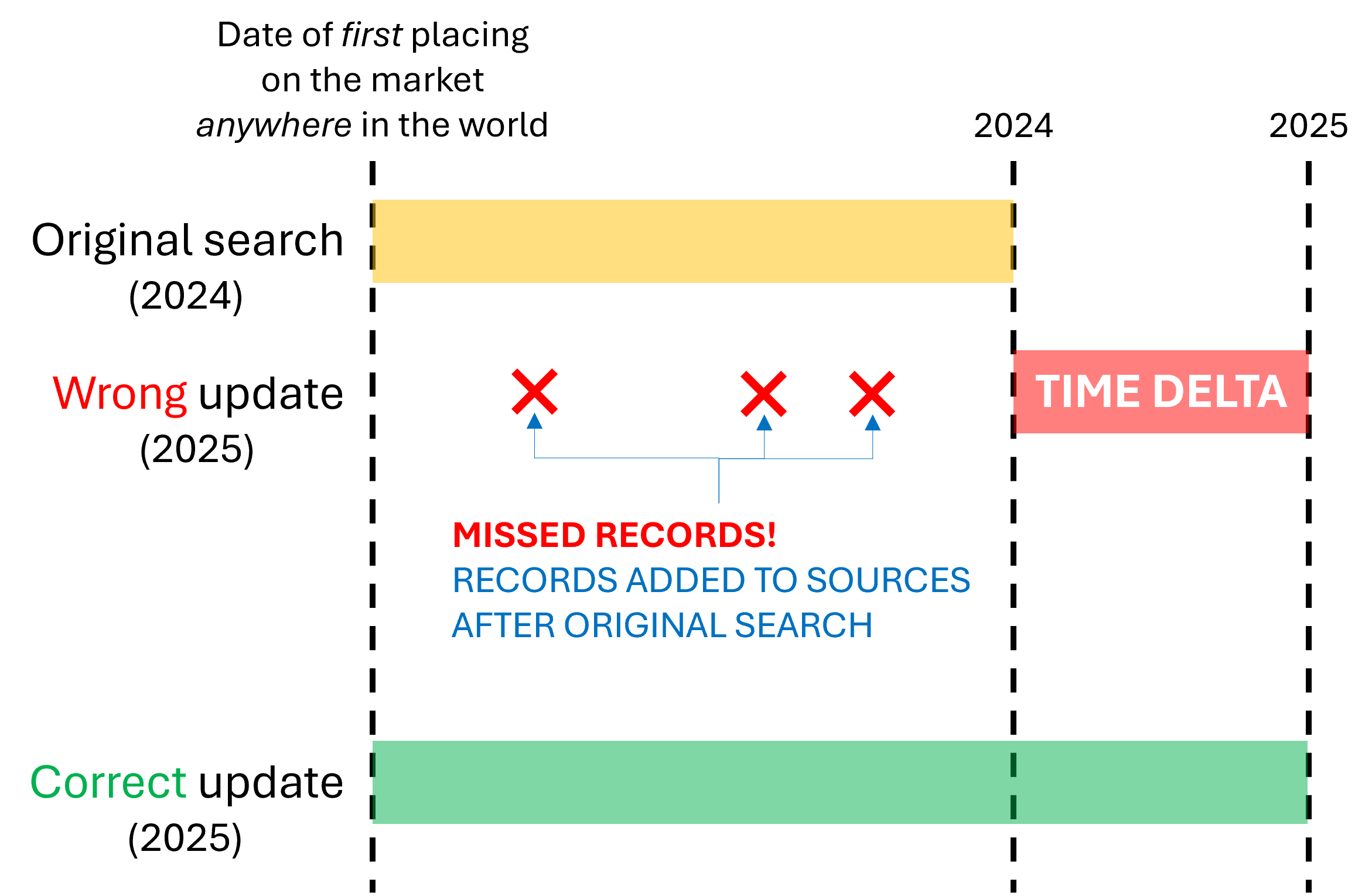
The correct way to update searches—whether for state-of-the-art reviews or post-market searches—is to repeat the search across the full planned time frame. If you follow our recommendation to perform post-market searches without restrictive time filters (see Section 2.4.3), this means that each search update should cover the entire period from date the device was first placed on the market (anywhere in the world) onward. This does not mean, however, that you need to re-screen old records or extract again their data. You can simply retain the results (screening and data extraction) from the previous search for any records that reappear in the updated results.
5.3 How long to udpate
You are expected to update PMCF throughout the lifetime of the device (see MDR Article 86, and IVDR, Article 81). For example, if a device has a lifetime of 6 years and you place the last device on the market in 2024, you are expected to keep your PMCF up-to-date until 2030.
Keep your searches up-to-date with minimum effort. Evidence is the only literature software that allows you to update searches in a methodologically correct way while minimizing effort. How does it work? Simply inform Evidence that you’re updating a search. Import the new results. Evidence will ensure that all your previous screening and data extraction work for earlier articles is preserved. Coming January 2025.
6 What to do with the data
2
How to use the information gathered from a post-market search depends on many factors, including the type of device, its claims, existing data, and the specific information identified during the search. While it is impossible to address every scenario here, our goal is to provide some examples to illustrate common application of the post-market search data.
MDR, Annex XIV, Part 6.1, and IVDR Annex XIII, Part 5.1 list possible uses of PMCF and PMPF data, which also apply to data from post-market searches. These uses are:
confirming the safety and performance of the device;
-
identifying previously unknown side-effects and monitoring the identified side-effects and contraindications (MDR);
-
identifying previously unknown risks or limits to performance and contra-indications (IVDR)
identifying and analysing emergent risks;
ensuring the continued acceptability of the benefit-risk ratio;
identifying possible systematic misuse.
Below we provide some examples or considerations.
6.1 Confirming safety and performance
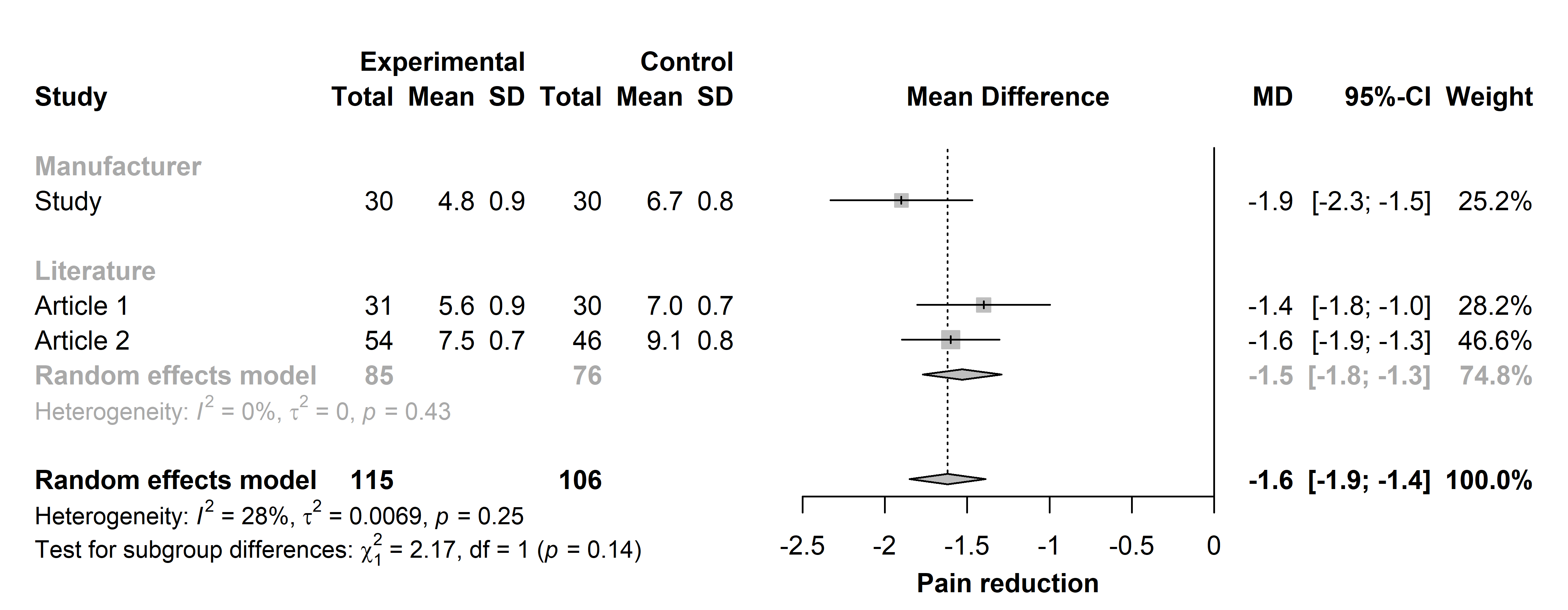
Post-market searches may uncover reports of third-party studies that meet the data requirements (e.g., study design, control group, intervention, sample size) specified in the clinical/performance evaluation plan for demonstrating the safety or performance of the device under investigation. Manufacturers can incorporate these literature data into their evaluation to confirm results from their own studies or to assess device performance at a later stage in its lifecycle.
Figure 6.1 illustrates an example of this approach using a subgroup meta-analysis. This method allows for combined analysis of datasets while maintaining transparency by presenting results separately for each subgroup (manufacturer data and literature data). In this example, the test for subgroup differences returns no significant differences (p > 0.05), strengthening the argument that the manufacturer and literature datasets are comparable and can be integrated.
For legacy devices, post-market literature data can play a pivotal role for certification since they may serve as the primary source for confirming device performance and safety in the absence of data from manufacturer studies, in accordance with MDCG 2020-6.
6.2 Unknown, known, and emergent risks and side effects
Unlike confirmatory data, unknown side effects, risks, and performance limitations do not require a specific level of evidence or population-based information for analysis. The mere occurrence of such events is sufficient for consideration. For this reason, reports that cannot estimate probabilities—such as case studies or incident reports (see Section 2.3.3)—can still play a critical role in identifying novel risks and side effects.
When novel risks or side effects are identified in studies with a known total population (e.g., cohort studies or registries), it may be possible to use these studies to estimate the probability of these events occurring. However, when quantification is not feasible—such as with isolated case reports or small-scale studies—a Post-Market Clinical Follow-up (PMCF) study may be required to investigate these risks or side effects in a controlled manner.
The novel identified risks and side effects must be than evaluated in the clinical evaluation, risk analysis and benefit-risk analysis.
Furthermore, risks and side effects do not need to be unknown to warrant consideration. For example, your risk analysis may have estimated the probability of a particular risk to be sufficiently low, such that no occurrences were expected in the field (with 95% confidence) given the anticipated number of devices and uses. However, a report of the occurrence of such a risk would necessitate a reassessment of the original estimation. Similarly, reports may emerge indicating that the frequency of a known side effect is higher than previously estimated or observed in prior studies.
It is also important to note that an event does not need to involve active harm to patients to warrant consideration. For instance, underperformance of a device in the intended population or in a specific subpopulation can also qualify for further investigation.
Finally, unknown risks and side effects may arise not only from post-market searches specific to the device under evaluation but also from analyses of similar devices. This is particularly relevant when issues are common across a device group or technology, as they may similarly impact the device being evaluated.
6.3 Identify systematic misuse
Post-market searches can be particularly useful for identifying misuse of a device. Under EU regulations, "misuse" includes off-label use and may also encompass unintentional actions or omissions. For example, it could include systematic user errors resulting from unclear information materials. This contrasts with the definition of "abnormal use" in IEC 62366, which refers exclusively to intentional actions (or intentional inaction).
If the post-market search for the device under evaluation, or similar devices, identifies systematic misuse, the manufacturer should assess potential actions to prevent the misuse or, alternatively, consider expanding the device’s intended purpose or target population.
References
-
AIMDD — Council Directive 90/385/EEC of 20 June 1990 on the approximation of the laws of the Member States relating to active implantable medical devices (AIMDD). Council of the European Communities, 1990
-
IEC 62366 — Medical Devices – Application of Usability Engineering to Medical Devices. IEC, 2015
-
ISO 13485 — ISO 13485:2016 – Medical devices – Quality management systems – Requirements for regulatory purposes. ISO, 2016
-
IVDR — Regulation (EU) 2017/746 on in vitro diagnostic medical devices. European Parliament and Council of the European Union, 2024
-
MDCG 2020-5 — Clinical Evaluation – Equivalence: A guide for manufacturers and notified bodies. MDCG, 2020
-
MDCG 2020-6 — Regulation (EU) 2017/745: Clinical evidence needed for medical devices previously CE marked under Directives 93/42/EEC or 90/385/EEC. MDCG, 2020
-
MDCG 2020-7 — Post-market clinical follow-up (PMCF) Plan Template. MDCG, 2020
-
MDCG 2023-3 — Questions and Answers on vigilance terms and concepts as outlined in Regulation (EU) 2017/745 and Regulation (EU) 2017/746. MDCG, 2023
-
MDD — Council Directive 93/42/EEC of 14 June 1993 concerning medical devices (MDD). Council of the European Communities, 1993
-
MDR — Regulation (EU) 2017/745 on medical devices. European Parliament and Council of the European Union, 2024
-
MEDDEV 2.7/1 — Guidelines on medical devices, clinical evaluation: a guide for manufacturers and notified bodies under Directives 93/42/EEC and 90/385/EEC. European Commission, 2016
-
ISO 13485 defines "medical device family" as the group of medical devices manufactured by or for the same organization and having the same basic design and performance characteristics related to safety, intended use and function.↩︎
-
Page MJ, McKenzie JE, Bossuyt PM, Boutron I, Hoffmann TC, Mulrow CD, et al. The PRISMA 2020 statement: an updated guideline for reporting systematic reviews. BMJ 2021;372:n71. doi: 10.1136/bmj.n71.↩︎
-
Page MJ, McKenzie JE, Bossuyt PM, Boutron I, Hoffmann TC, Mulrow CD, et al. The PRISMA 2020 statement: an updated guideline for reporting systematic reviews. BMJ 2021;372:n71. doi: 10.1136/bmj.n71.↩︎
-
BMJ 2021;372:n160↩︎